

In Western North Carolina, power lines and big trees share a lot of space. Lines run along winding mountain roads, through wooded lots, and up long private driveways to homes tucked into the hillside. When trees and wires meet, the result can be outages, fires, property damage, and serious safety risks.
One of the most common questions we hear from homeowners around Hendersonville, Flat Rock, Etowah, and Columbus is simple: Who is responsible for trimming trees near power lines? The answer depends on which line it is.
Not All Power Lines Are the Same
Before you call anyone, figure out which type of line you’re dealing with.
Primary Distribution Lines
These are the high-voltage lines running along roads and across properties on utility poles. They carry power to entire neighborhoods. Utility companies are responsible for keeping these lines clear, and they handle that trimming with their own line-clearance crews or contractors.
Service Drops
The service drop is the line running from the utility pole to your house. Responsibility for trees around this line varies by utility. In many cases, the homeowner is responsible for keeping trees trimmed away from it, but utilities will often temporarily disconnect power so a tree service can work safely. Always call your utility first to confirm their policy.
Private Lines
On many mountain properties, power runs past the meter on lines owned by the property owner, feeding a barn, workshop, guest house, or a home at the end of a long driveway. These private lines are entirely the owner’s responsibility, including keeping trees clear of them. That means the trimming, the cost, and the liability if a tree causes a problem.
Understanding Utility Easements
Most primary lines sit within a utility easement or right-of-way, a strip of land where the utility has legal rights to access, maintain, and protect its lines, even though you own the property.
Within that easement, utilities can typically trim or remove trees that threaten the lines. Homeowners are sometimes surprised by how aggressive this trimming can look. Utility crews focus on line clearance and reliability, not on the tree’s shape or long-term health.
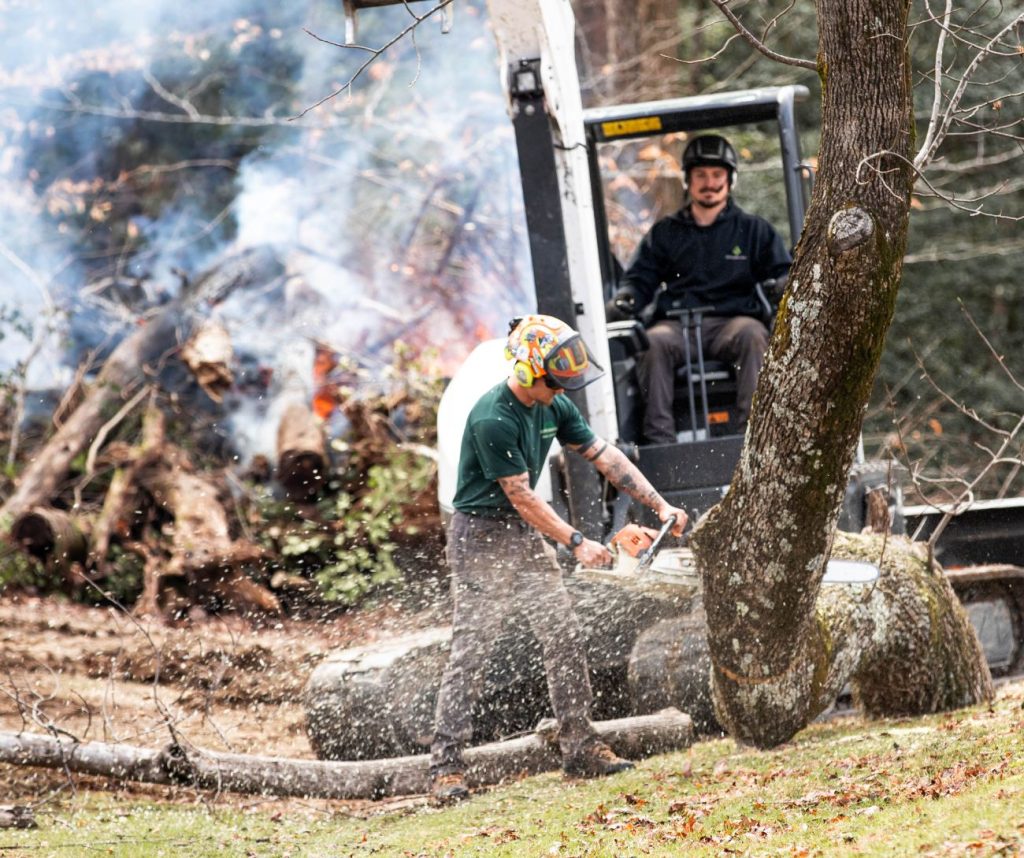
A few things to know:
- Check your property records. Your deed or plat will show any recorded easements. If you’re buying land, our pre-purchase arborist inspection can flag trees near lines before you close.
- Talk to the utility early. If trimming is scheduled, ask what work is planned and whether any trees will be removed.
- Plan what you plant. Avoid planting tall-growing trees in or near easements. Choose small, low-growing species instead.
Why You Should Never Trim Near Power Lines Yourself
Electricity can jump, or “arc,” from a line to a nearby branch, ladder, or tool without direct contact. Under OSHA rules, workers who aren’t qualified for line-clearance work must generally stay at least 10 feet away from energized overhead lines. Wet branches, aluminum ladders, and pole saws make the danger even worse.
If a tree is touching or close to a line, don’t try to fix it yourself. Never touch a tree or branch that’s in contact with a wire, and treat every downed line as live.
How a Professional Tree Service Helps
Even when the utility handles the primary lines, there’s plenty a professional arborist can do:
- Trim around service drops and private lines. Our tree removal and trimming team works with your utility to schedule disconnects when needed.
- Correct the damage from utility trimming. Hard line-clearance cuts can leave trees lopsided or with stubs. Restorative pruning improves balance and helps the tree recover.
- Remove trees that will keep causing problems. A fast-growing tree right under a line may be better replaced. In tight spaces, crane services allow controlled removal, and stump grinding clears the way for a better-suited replacement.
- Spot weak trees before they fall. Dead, decaying, or leaning trees near lines are the most likely to cause outages. Our tree and shrub health services and insect and disease control help catch declining trees early, and tree cabling can support weak limbs on trees worth saving.
When a Tree Hits a Line
If a storm drops a tree onto a power line, stay far away and call your utility immediately. Once the utility has made the line safe or cut power, our 24/7 emergency services team can clear the tree from your home, driveway, or yard.
Keep Your Lines Clear With Epperson Tree Service
For more than 20 years, Epperson Tree Service has helped Henderson County property owners manage trees in challenging spots, including near power lines on steep mountain terrain. Our team includes four ISA Certified Arborists, and we are TCIA Accredited.
Whether you need trimming around a service drop, help with a private line, or advice after utility crews have come through, contact us today to schedule an assessment.

